
The real reason you’re losing your hair. And why every treatment you’ve been sold comes in too late.
I went bald doing everything the industry told me to. Then I read the studies myself. This video is what I found, in plain English, with the research on screen. Press play.

Read this before you press play
At I show you the device I built and use on my own head. I run the company that makes it. Some people in the comments said that made them doubt the whole video. Fair enough.
So here’s the deal. The first 47 minutes are the research. Nothing in them is for sale. You can watch the science and never buy a thing. Every study is on the evidence board further down this page, so you can check it yourself. I’d rather you understood the problem than bought anything from me.
It’s a long video. You don’t have to watch it in order.
Tap a chapter and the video jumps straight there.
Here’s the short version.
The video goes deep. This is the part you need, in plain words.
Everyone said it was genetic. Nobody could tell me why it’s always the same shape.
Men go bald in a pattern. The temples go back. The crown thins. But the hair around the back and sides stays put, often for life.
Here’s the problem with the usual explanation. DHT, the hormone that gets the blame, flows through your whole scalp. The follicles on top and the follicles at the back are soaked in the same blood. So if DHT alone caused baldness, you’d lose hair everywhere. You don’t.
Something has to be different on top. In 2015 a researcher in Spain built a computer model of the scalp to find out what. He mapped where the scalp is pulled tightest. Then he laid that map over the standard chart of male hair loss. They matched. Where the scalp is tight, hair goes. Where it’s loose, hair stays.

10sTry this now. It takes ten seconds.
Reach round to the back of your head, just above the neck. Pinch a fold of skin between your thumb and finger. Notice how easily it lifts. It slides over the bone.
Now do the same on top of your head, at the crown or the corners of your hairline. For most men who are losing hair, it barely moves. The skin feels stuck to the skull.
Loose at the back. Locked on top. That’s not a coincidence.
It’s a sign, not a diagnosis. But keep it in mind, because it’s about to make a lot of sense.
A tight scalp squeezes the blood supply.
A hair follicle is a tiny organ. It needs blood, oxygen and room to grow. Stretched over the top of your skull is a tough sheet of tissue, held by muscles at the forehead, the temples and the back of the head. In some men those muscles hold it pulled tight, day and night. It tends to run in families. Stress makes it worse.
When that sheet is tight, the tiny blood vessels under it get squeezed. This has been measured. Balding scalps get about 2.6 times less blood flow than the back of the same head. They’re thinner, too. A 2021 study measured the scalps of balding men at 5.9 millimetres, against 7.8 in men who weren’t balding. And they’re harder, exactly where hair goes first.
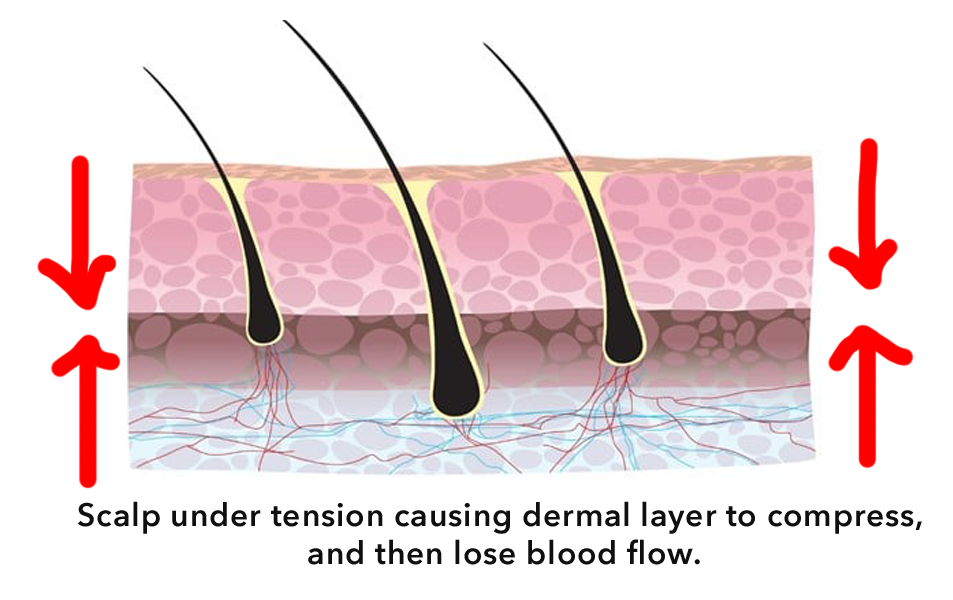
Then the scalp hardens around the follicle.
Tissue that’s squeezed and starved of blood gets inflamed. In an inflamed scalp, DHT does its damage. It triggers a signal that tells the scalp to lay down scar tissue. Doctors call it fibrosis. The scalp gets thin, hard and shiny. The follicle gets less room and less blood with every hair cycle. It doesn’t die. It shrinks. Each hair comes back finer than the last, until all that’s left is fuzz.
This is the part that explained everything I’d been sold. DHT blockers stop new scar tissue forming, but they don’t remove what’s already there. That’s why finasteride stops hair loss but barely regrows anything. Minoxidil pushes blood into a scalp that’s still clamped shut, so it works a bit, and only while you keep using it. And it’s why women almost never go bald in this pattern. They have the same tension. They have about a tenth of the DHT.

Why every treatment you’ve been sold comes in too late.
Hair loss isn’t one event. It’s a chain. Here’s the chain, and where each treatment steps in.
Scalp tension
The muscles hold the scalp tight over the crown and hairline. This is where it starts.
The scalp gets squeezed
Blood flow to the follicles drops.
Inflammation
Squeezed tissue with too little blood becomes inflamed.
DHT does its damage
In an inflamed scalp, DHT locks on and makes it worse.
A scar signal is sent
The scalp is told to start laying down scar tissue.
Scar tissue forms
The scalp hardens around the follicles.
The follicle gets squeezed
Less room, less blood.
The follicle shrinks
Each hair grows back finer than the last.
Hair loss in a pattern
By the time you see it in the mirror, the chain has been running for years.
Look at where the money is. Every treatment sits at step 4, 6 or 7. None of them touch step 1. And there’s a business reason for that.
A treatment for step 1 gets bought once. A treatment for step 4 or 7 gets bought every month, for life, because the moment you stop, the chain starts again. One hair loss company has over two million subscribers on that model. Nobody funds research into the cause, because a cure has no monthly revenue. That’s the dirty secret. It isn’t a conspiracy. It’s a spreadsheet.
So what loosens the scalp?
The obvious fix is the opposite of tension. Loosen the scalp and get blood moving through it again. The research backs this up.
In 2016, a Japanese study had men massage their scalp for four minutes a day. After 24 weeks, their hair was measurably thicker. In 2019, a survey of 340 men who massaged regularly found that 68.9% reported their hair loss had stopped or reversed. On average it took 36 hours of total massage before they noticed a change. That’s about ten minutes a day for seven months.

There’s an even stronger piece of proof at . Doctors injected the muscles around the scalp with a substance that makes the muscles relax. Hair counts went up, without touching hormones. It costs up to $1,300 a session and wears off, so it never became a treatment. But it tells you something. Take the tension off, and hair comes back.
Here’s the catch with massage. Thirty-six hours is a lot. Your hands cramp. You can’t reach the crown with any real force. It’s boring. Most men quit inside a month. That’s why I built something to do it for me.
What I did about it.

A scalp massager engineered specifically for hair loss.
It sits on your head like a headband and lifts and releases your scalp for you. Hands-free, ten to twenty minutes a day, while you work, cook or watch TV. It works on step 1 of the chain. As far as I know, it’s the only thing built to.
It doesn’t replace anything you’re already using. For a lot of men it’s the missing piece underneath. Two things you should know. It takes months, not days, because you’re changing tissue that took years to tighten. And you get 180 days to test it, and send it back if it doesn’t work for you.
How it works, real results, price and the guarantee, all on one page.
 Before
Now
Every claim in the video is on this board.
Want to look at something for longer, or track down a paper? This is the board I built the presentation from. Zoom in, move around, find the study. If you have a question, ask it in the YouTube comments. We reply to every one.
The board opens here on the page. Pinch or scroll to zoom, drag to move around.
Your hair is being squeezed out.
Everything you’ve been sold works further down the chain, which is why it stops working the day you stop paying. Fix the squeeze, and the chain stops at the start. That’s what the Growband is built to do.
180-day money-back guarantee · 10,000+ men · Rated 4.7 / 5
P.S. If you’re only going to watch four minutes, watch . That’s the fix, in four steps. Then decide for yourself.
4,200 comments and counting.
All of these are under the video on YouTube. Go and check.
I have a Masters Degree in Chemical Engineering, and I am trying to figure out on how to reverse my hair loss, this video was MADE for me, lol
866I’ve seen many university research presentations on a number of topics. Your video is at that level. I am totally impressed. The information is very helpful.
224I was massaging my scalp watching this entire video
155WOW, I did not expect to actually receive NEW information on what really causes hair loss. Well done, mate! Amazing presentation.
111Thanks for this video, it makes way more sense than some hairs mostly on the back and sides of head are magically DHT resistant
53Dude, thank you! From the bottom of my heart. I started to notice hair loss around a year ago, then I followed your advice to massage (by hand) for 6+ months now. I really have more hair, and my confidence is back.
18