
He raised his arm in 1973 — and never lowered it. What happened to it explains how you go bald.
It has almost nothing to do with the hormone you've been told to blame — and everything to do with a single, overlooked force acting on your scalp every day.

Fig. 1 Sadhu Amar Bharati, who raised his right arm in 1973 and kept it aloft for more than three decades.
In 1973, an Indian man named Sadhu Amar Bharati raised his right arm toward the sky as an act of religious devotion — and made a vow never to lower it again. He kept that vow for more than thirty years.
What happened to the arm is the part worth paying attention to. It did not stay a normal arm. Slowly, over the years, it withered — the muscle wasted away, the skin tightened over bone, the joint fused, and the limb shrank into a thin, rigid stick. It was not disease. It was not injury. Nothing infected it.
The arm died for one simple reason: held above his heart year after year, it stopped receiving a healthy supply of blood. Starved of the oxygen and nutrients that blood delivers, the living tissue had no way to maintain itself — so it slowly broke down.1
This is a dramatic, almost unbelievable story. But the principle behind it is one of the most basic facts in all of biology — and it is happening, in miniature, on the head of almost every balding person alive.
Cut off a tissue's blood supply, and it withers. Your hair follicles are no exception.
To understand how you lose your hair, you have to forget — just for a moment — almost everything you've been told about hormones. The real story starts not with chemistry, but with plumbing: with blood, pressure, and a tissue slowly being starved. Over the next few minutes, we'll build the explanation piece by piece, exactly as the evidence does.
A hair follicle is a tiny living organ — and it lives on blood
A follicle isn't a passive hole that hair grows out of. It's a small, busy organ — one of the few in the body that builds, sheds, and rebuilds itself on a repeating cycle throughout your life. And like any organ, it depends on a constant supply of oxygen and nutrients, delivered by a fine network of blood vessels that feed into its base, the dermal papilla.2
When that supply is generous, hair grows back thick, dark, and deeply rooted. When it's restricted, the follicle does exactly what Bharati's arm did: it begins to shrink. Each growth cycle produces a slightly finer, shorter, weaker hair — a process called miniaturisation — until the follicle finally falls dormant and grows nothing visible at all.
Visible baldness is the end of a long process of starvation — not a sudden event. The follicles don't vanish; they're slowly choked of their blood supply.
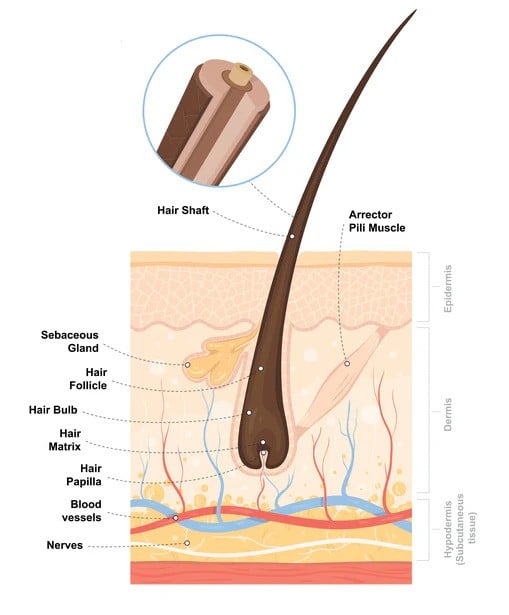
The bulb (dermal papilla): the follicle's engine room, where each new hair is built — wholly dependent on its blood supply.
The blood vessels: deliver oxygen and nutrients. Narrow them and the engine starves.
The shaft: the hair you see. Its thickness is a direct readout of how well-fed the bulb is.
The clue hiding in plain sight: hair loss follows a map
Here is the fact that should bother anyone who has been told hair loss is "just DHT" — the hormone, a by-product of testosterone, blamed on nearly every shampoo bottle and supplement label.
DHT circulates in your blood. It reaches every follicle on your head in roughly equal measure. So if DHT alone were destroying follicles, baldness should be random — scattered, patchy, different on every head.
It is the opposite of random. Male pattern baldness unfolds in an almost identical sequence on head after head: the temples retreat, the crown thins, and the two zones spread until only a familiar horseshoe of hair remains around the back and sides — hair that is almost never lost, no matter how advanced the baldness. Physicians charted this so reliably that it became a formal scale: the Norwood–Hamilton stages.3

If every follicle receives the same DHT, why is hair always lost in the same specific places — and why is the back of the head spared almost without exception? A hormone carried evenly in the blood cannot, by itself, draw such a precise map. Something local must be involved.
The scalp is stretched over the skull like a drum
And like a drum, where it's pulled tightest, the pressure underneath is greatest.
Across the top of your head lies a tough, fibrous sheet called the galea. It has almost no blood supply of its own and very little stretch. Anchored to its edges are several muscles — at the forehead, the temples, and the back of the skull — that can pull on it like cords around the rim of a drum.4
When those perimeter muscles stay chronically tense — through stress, habitual expression, clenching, or simple genetic predisposition — they hold the galea taut. That sustained tension presses down on the thin layer of tissue just beneath the skin: the dermal layer, the exact place where follicles and their delicate blood vessels live.
Tightest across the top, front, and crown — precisely where hair is lost first. The back and sides sit below the muscle line, barely tensioned at all — precisely where hair survives.

High-tension zone (top, crown, temples): the galea is pulled tightest — and hair disappears here first.
Low-tension zone (back & sides): below the muscle line, barely compressed — and almost always retained.
“Mechanistically, the scalp behaves like a drum skin with tensioning muscles around the periphery. These muscle groups can create a ‘tight’ scalp when chronically active.”
— Dr. Brian J. Freund, on scalp muscle tension4A computer model turned the idea into a testable prediction
A theory earns its keep by predicting something it wasn't built to explain. So researchers constructed a three-dimensional computer model of the scalp and skull, applied the known forces from those perimeter muscles, and calculated one thing only: where the mechanical pressure would concentrate in the dermal layer.5
The model knew nothing about hair. It was pure physics — a tensioned surface over a curved dome. The question was simply: where does it squeeze hardest?
The result
The map of greatest compression matched the Norwood–Hamilton baldness pattern — almost stage for stage.
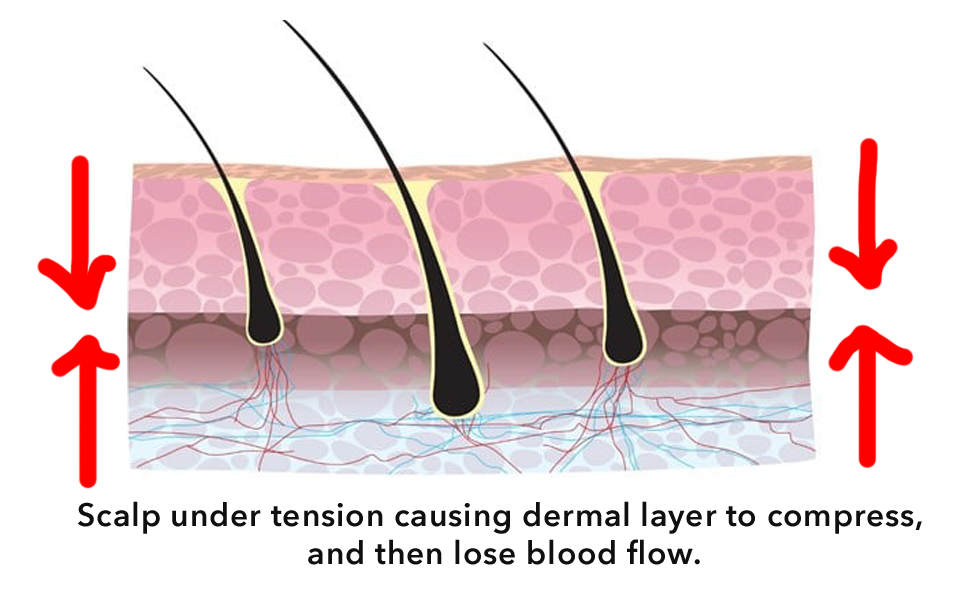
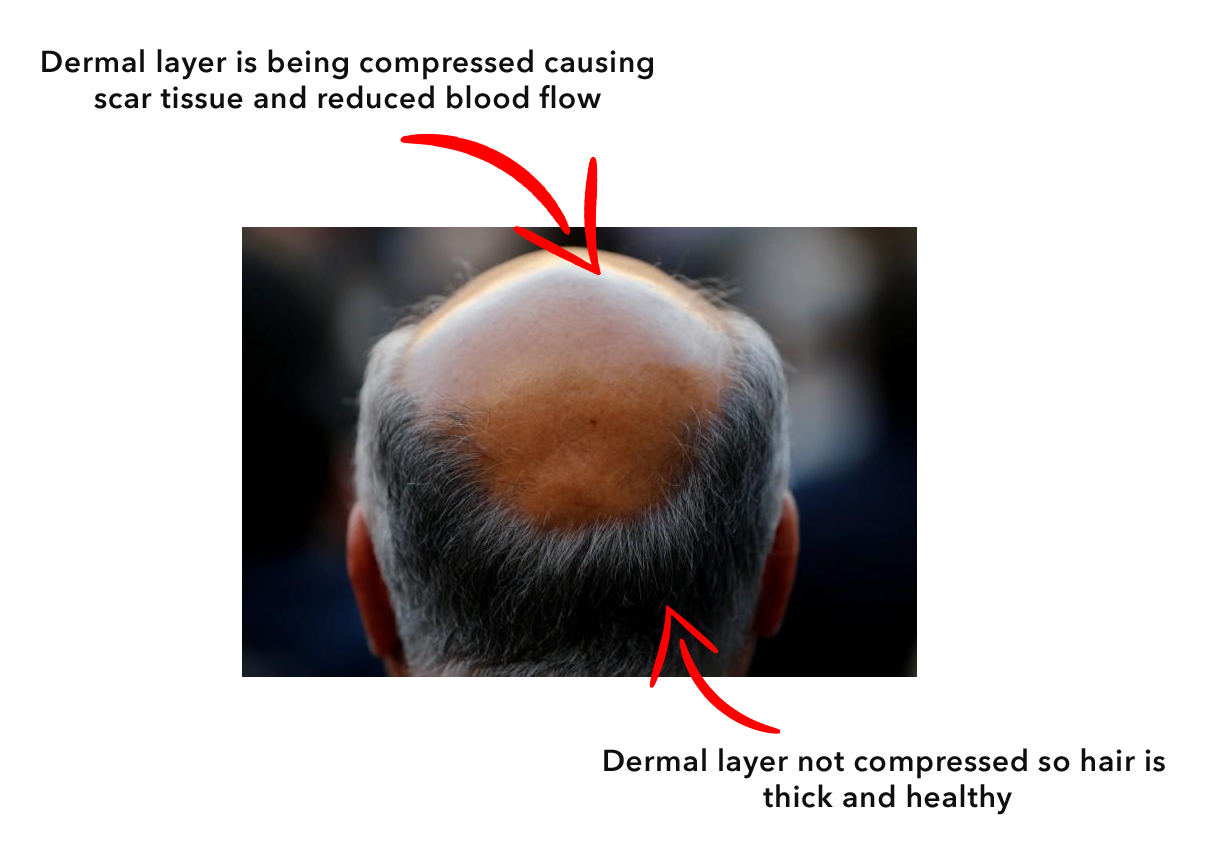
The pattern of baldness mirrors the pattern of tension — not the spread of a hormone.
This is the moment the anomaly from Part II dissolves. Hair loss follows a fixed map not because DHT singles out certain follicles, but because mechanical force is distributed across the scalp in a fixed pattern. The hair you lose is, quite literally, the hair under the most pressure — and the most starved of blood as a result.
How tension quietly shuts down a follicle
Not in a day — as a slow chain reaction that plays out over years.
Tension builds
The perimeter muscles stay chronically active, holding the galea — and the skin over it — under constant tension.
The dermal layer compresses
That tension presses on the thin layer of tissue where follicles and their blood vessels sit.
Blood flow falls
Compressed vessels carry less blood — so less oxygen and fewer nutrients reach the follicle. Balding scalps measure markedly lower blood flow than healthy ones.6
Scar tissue forms
The body answers chronic compression by laying down fibrous tissue — which carries even fewer vessels, tightening the squeeze further.
The follicle miniaturises
Starved cycle after cycle, the follicle shrinks — finer, shorter hairs — until it falls dormant. This is what visible balding actually is.
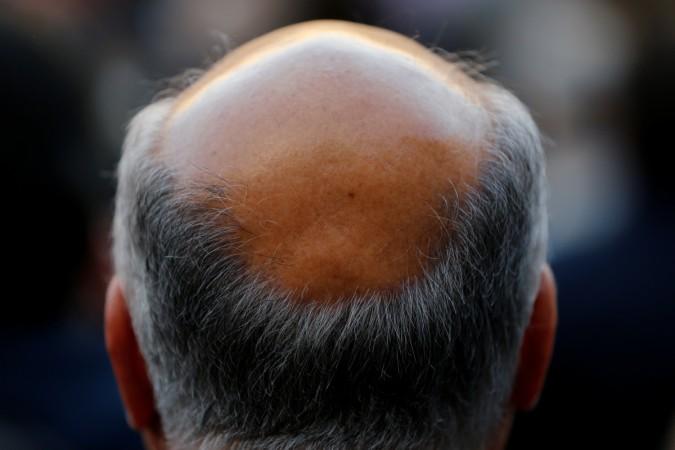
And this explains the survivors. The back and sides keep their hair because they sit in the scalp's lowest-tension zone — the one region where this cascade never truly gets going. Same hormones, same bloodstream, entirely different outcome — decided by mechanics.
So where does DHT genuinely fit?
None of this means DHT is a myth. It is real, and it matters. The accurate way to describe it is as an accelerant rather than the original spark.
The evidence indicates DHT speeds the formation of scar tissue. In a scalp region already tense and short on blood, DHT pours fuel on a fire that mechanical tension lit. Read that way, a series of otherwise puzzling observations line up at once:
- Men with higher DHT often bald faster and more severely — more accelerant, faster burn.
- Women, with far lower DHT, rarely follow the same aggressive pattern.
- DHT blockers such as finasteride can slow or halt loss — they remove the accelerant, but leave the underlying tension and poor blood flow untouched.
- The back and sides keep their hair despite the same DHT in the blood — because there is little tension there for DHT to amplify.
DHT worsens the damage where tension has already weakened the ground. Block the accelerant and you slow the fire; address the mechanical root cause and you deal with where the fire actually starts.
Five separate experiments — all pointing the same way
A single study can mislead. What makes the tension–blood-flow model hard to dismiss is that completely different kinds of research, run for completely different reasons, keep converging on one lever.
The muscle-relaxant study
The scalp's perimeter muscles were injected with a muscle relaxant to ease their downward pull for several months — a direct test of the tension idea.
The 2019 scalp-massage study
Some 300 participants performed regular manual scalp massage — no drugs, no surgery, just consistent mechanical pressure over time.
PRP therapy
An expensive clinic procedure that concentrates a patient's own blood platelets and injects them straight into the scalp.
Blood-flow comparison
Direct measurement of scalp circulation in balding versus non-balding men, using blood-perfusion monitoring.
Why transplants can fade
Transplants move hair from the low-tension "safe zone" to the high-tension top. The follicle survives the move — its new environment does not change.
Five methods. One answer.
Relax the muscles, massage the tissue, inject blood, measure circulation, or relocate a follicle — every route returns to the same variable.
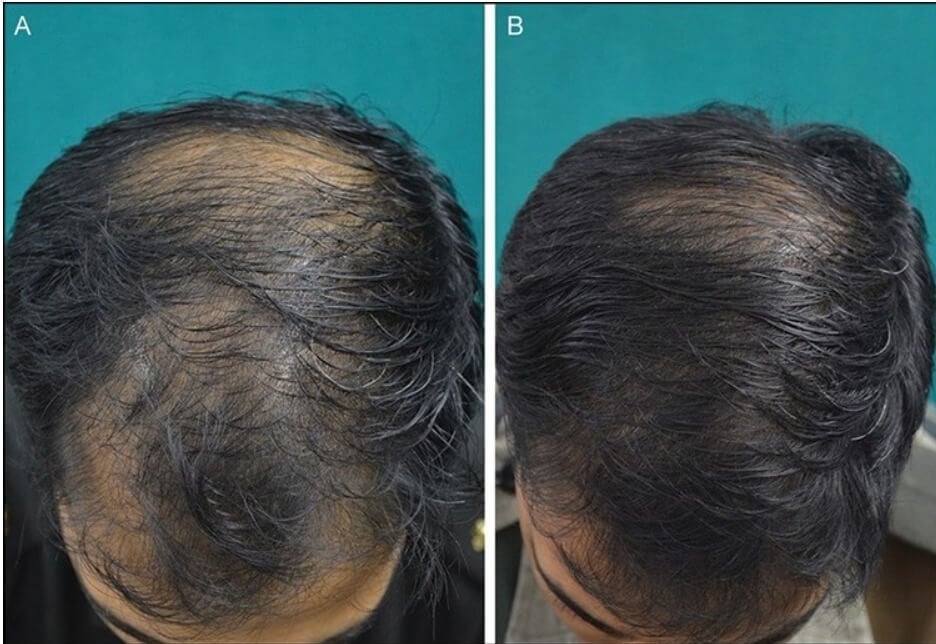
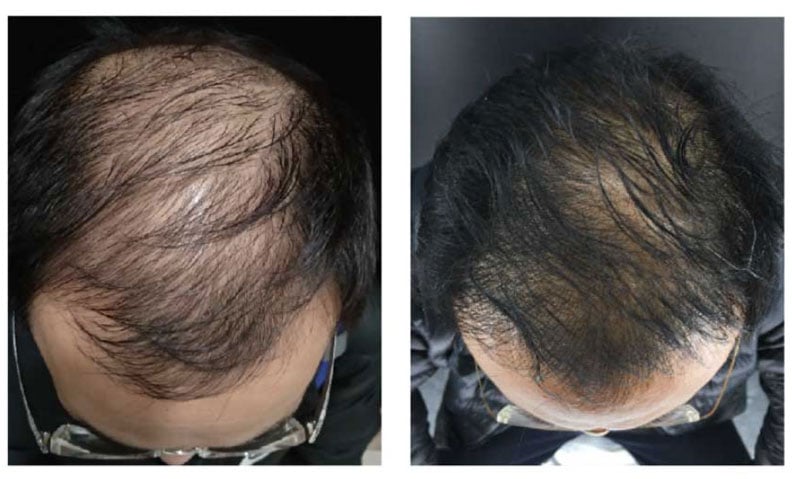

The case, assembled
- Follicles are living organs that depend entirely on blood flow.
- Chronic scalp tension compresses the tissue and throttles that supply — in a fixed pattern.
- That pattern matches the Norwood map — which a blood-borne hormone alone never could.
- And five independent lines of research agree: restore blood flow, and hair responds.
There is a proven fix — and a very human reason it fails
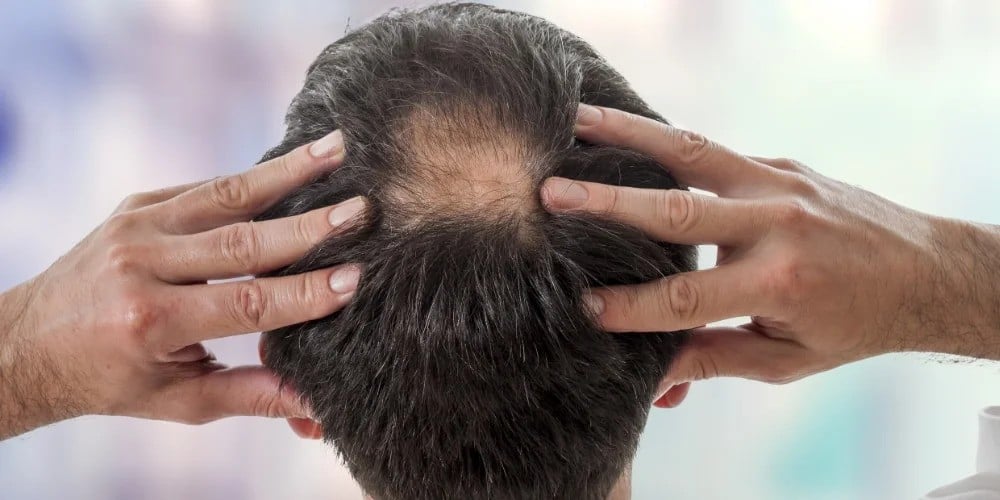
Of those five routes, the most accessible by far is scalp massage. It's free, drug-free, and the changes it makes are physical — remodelling the tissue itself rather than masking a symptom.
But the massage research points to a demanding target: on the order of 36 cumulative hours of consistent massage before the best results appear. That's roughly ten to twenty minutes a day, every day, for months.8
And that is where almost everyone fails. Done by hand it is tedious, the fingers tire, and the time is nearly impossible to track. Most people quit long before the threshold — which is the real reason so few have ever heard that massage works at all.
It isn't the science. It's consistency. A proven method is worthless if it's too tedious to finish.
If the science is the massage, the Growband is simply the discipline
Everything above is the "why." This is one practical way to act on it — a device built to make those 36 hours actually happen, without depending on willpower.
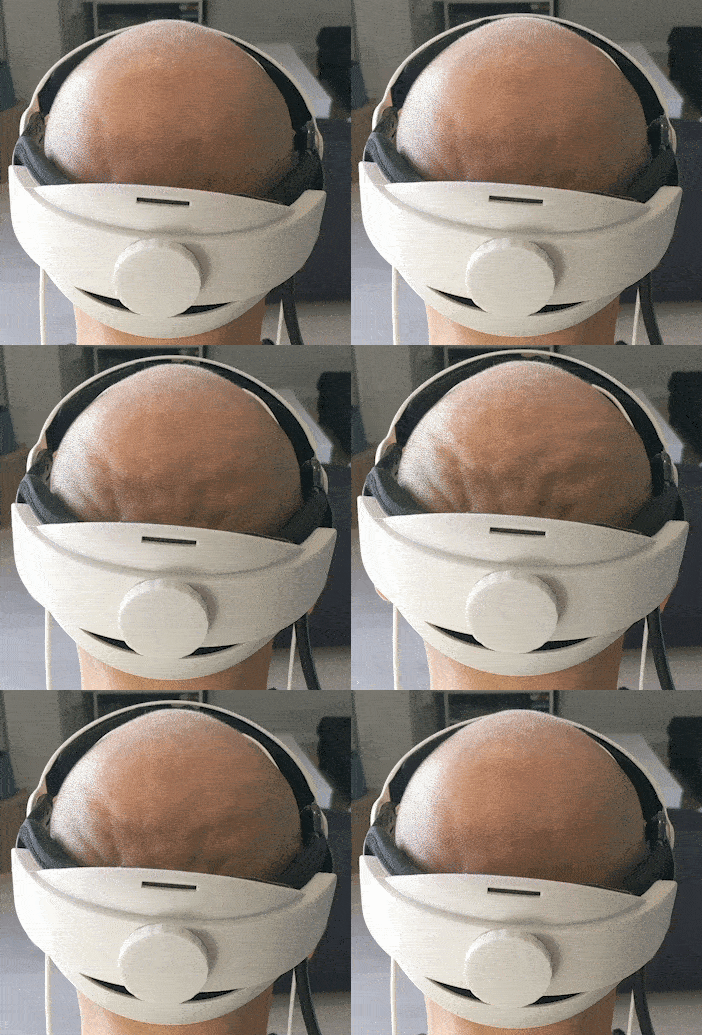
The Growband Pro is a hands-free device developed with researchers from the University of Bristol and University of Birmingham. It performs the mechanical work of scalp massage for you — applying the same upward pressure and movement automatically, while you sit and relax.

Massage action
Mechanical upward pressure across the scalp perimeter — no hand fatigue, no technique to learn.

Targets tension
Works the perimeter muscles where chronic tension and compression begin.

Encourages blood flow
Stimulation supports circulation to the dermal layer — the lever every study returned to.
- Removes the one thing that makes massage fail: the effort of doing it by hand.
- Addresses the mechanical root cause, not only the DHT accelerant.
- Can be used alongside minoxidil, DHT blockers, or caffeine shampoo.
Developed with University of Bristol & Birmingham researchers.

Does it move the variable that matters?
Since blood flow is the whole argument, it is the thing worth measuring. Test subjects were fitted with blood-perfusion monitors, and scalp circulation was recorded — in Blood Perfusion Units — before, during, and after use.
The recordings showed a clear rise in dermal-layer blood flow during use that remained elevated afterward — precisely the mechanism the tension model calls for.
Illustrative of measured BPU trends. See references.

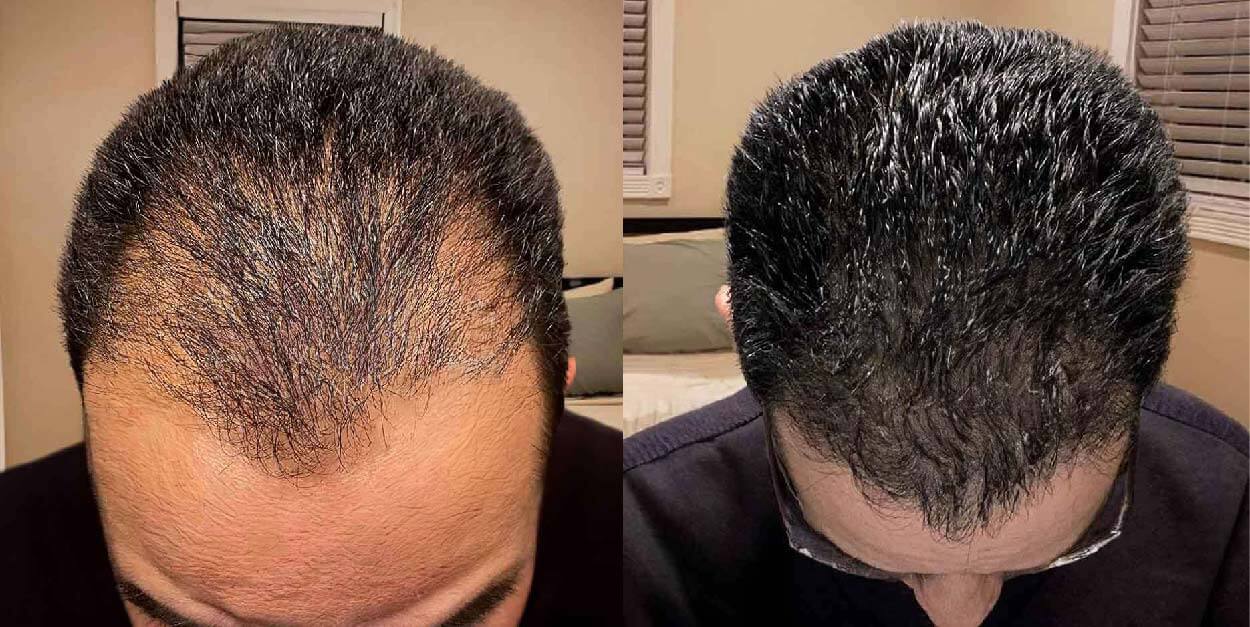
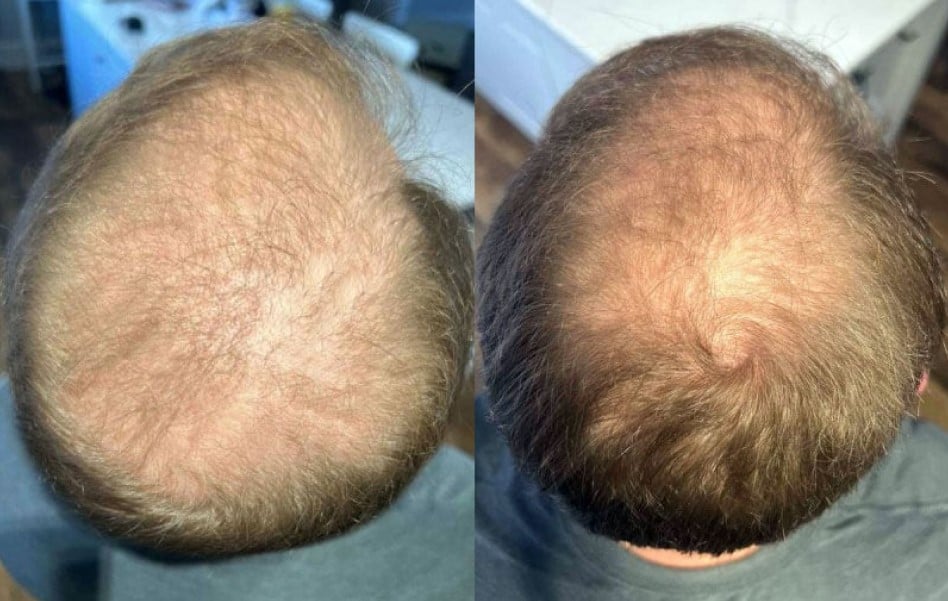
What people using the Growband are seeing
Scalp changes often appear first, with regrowth following. Results vary between individuals.


Return, for a moment, to the man with the raised arm. His story is extreme — but it makes visible a principle that is otherwise invisible: living tissue, deprived of blood, slowly dies. The same quiet process, driven by tension instead of a vow, is what thins and erases hair in the same predictable map, on head after head.
Seen this way, hair loss stops being a mystery of hormones and becomes a question of mechanics and circulation — something you can actually understand, and therefore something you can actually address at its source.
References & Notes
- Reduced perfusion and disuse atrophy — general physiological principle: prolonged immobilisation and elevation reduce limb blood supply, leading to muscle wasting and tissue atrophy. (Illustrative case: Sadhu Amar Bharati, widely documented in press.)
- Hair follicle biology and the role of the dermal papilla and its vascular supply in the hair growth cycle.
- Norwood O.T. Male pattern baldness: classification and incidence. Southern Medical Journal (Hamilton–Norwood classification).
- Freund B.J. et al. Work on scalp muscle tension and its mechanical contribution to pattern hair loss.
- English R.S. A hypothesis for the mechanism of androgenetic alopecia: scalp tension, mechanical force and dermal compression (incl. computational modelling of scalp stress).
- Comparative scalp blood-perfusion measurements in balding versus non-balding scalps (laser Doppler / perfusion monitoring literature).
- Botulinum-toxin (muscle-relaxant) studies in androgenetic alopecia reporting hair regrowth following reduction of scalp muscle tension.
- Standardised scalp-massage study (2019): self-reported hair-loss stabilisation/regrowth and cumulative massage time. Self-reported survey data.
- Platelet-Rich Plasma (PRP) clinical literature on hair regrowth in androgenetic alopecia.
This article is informational and is not medical advice — it is not intended to diagnose, treat, cure, or prevent any condition. The scalp-tension model of hair loss is an active area of research; some cited findings rely on small samples or self-reported data, and individual results vary. Hair loss can have multiple causes. Consult a qualified healthcare professional about your individual situation before starting any new treatment.